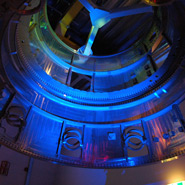
| Spare robot arm developed by Dutch Space to set off for Space Station |
|---|
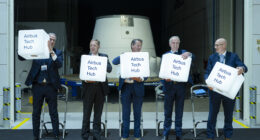
Leiden/ Noordwijk, The Netherlands, May 12, 2010 - Space Shuttle Atlantis, ready for liftoff on Friday May 14th, will deliver ESA's spare hardware for the European Robotic Arm (ERA) to the International Space Station. The ERA hardware, including the spare elbow joint of the arm, will be launched as payload on the Russian-built Mini Research Module MRM-1. Bringing the ERA spare to ISS is a significant step towards the launch of the actual flight model of the robotic arm, scheduled in 2012, providing a robotic servicing system that will be used in the operation of external payloads on the Russian segment of the ISS.
| | | | Dutch Space provides solar arrays for Sentinel satellites |
|---|
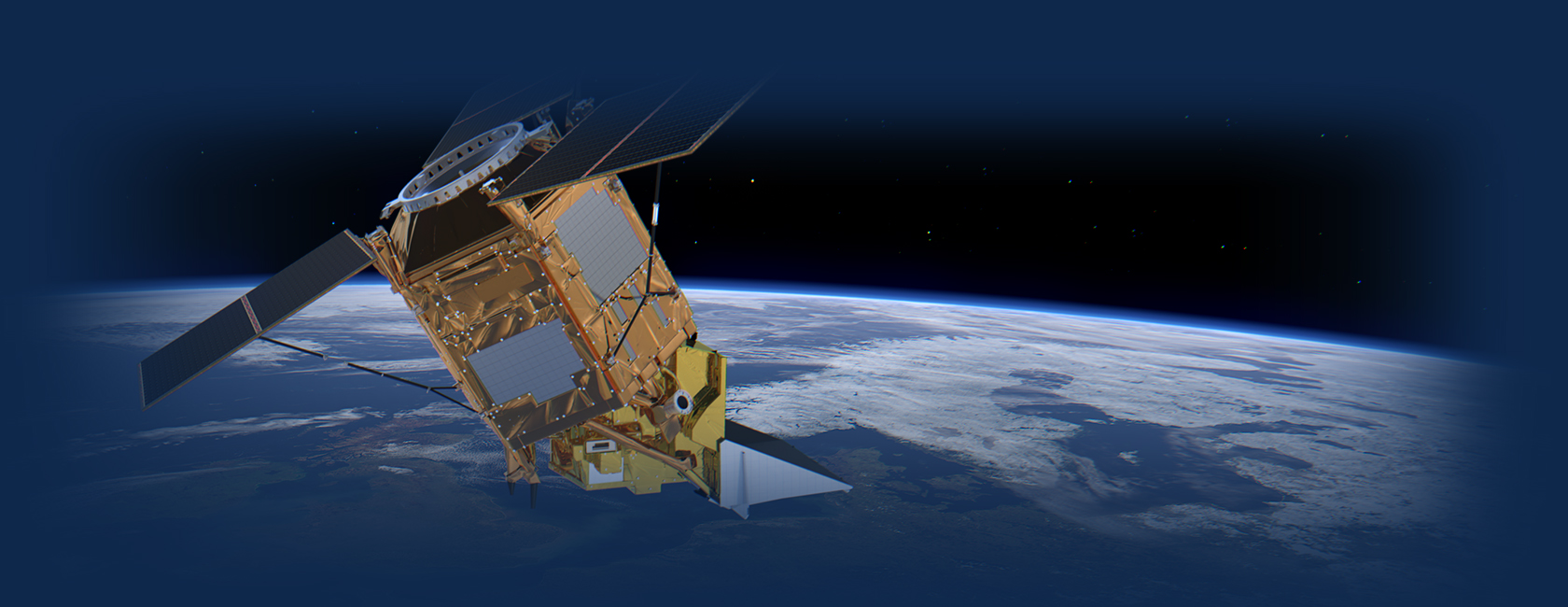
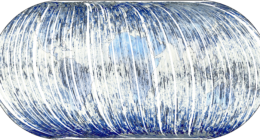
Leiden, 23 February 2010 - Dutch Space, leading space company in the Netherlands, has been granted two new contracts for the delivery of solar panels for the Sentinel-1 and Sentinel-2 satellites. These satellites are part of the international Global Monitoring for Environment and Security (GMES) program of the European Union and ESA. The contract for Sentinel-1, representing a value of EUR 13.4 million, has been closed with the Italian Thales Alenia Space. For Sentinel-2 Dutch Space was granted a EUR 10.3 million by EADS Astrium in Friedrichshafen.
| | | | Environmental certificate ISO 14001 for Dutch Space |
|---|
Leiden, December 17, 2009 - Dutch Space, leading space company in the Netherlands, achieved the international environmental standard ISO 14001:2004. ISO 14001:2004 is considered the standard for a verifiable environmental management system, aimed at controlling and improving the environmental performance of companies. To achieve this norm, business management must meet strict requirements. Dutch Space is committed to continuous improvement of the environmental performance of the organization. With certification Dutch Space reaches one of its objectives that were voluntarily set early this year.
| | | | Dutch Space Selected By Orbital Sciences Corporation to Supply Solar Arrays for International Space Station Resupply System |
|---|
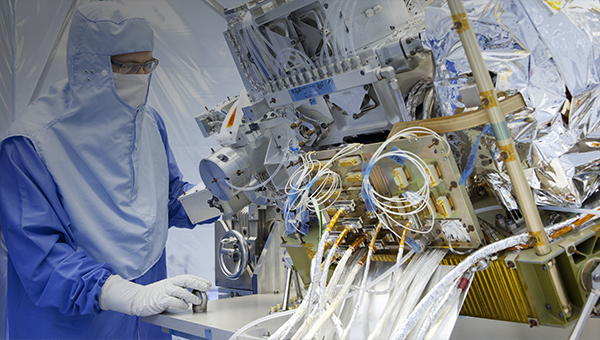
Leiden, The Netherlands / Dulles, VA, 12 November 2009 - Dutch Space, leading space company in the Netherlands, signed a contract with Orbital Sciences Corporation (NYSE: ORB) for the development of solar arrays for NASA's new cargo missions to the International Space Station (ISS) to be carried out under NASA's Commercial Resupply Service (CRS) project. The more than USD 35 million contract covers the design, manufacturing, assembly, integration and testing of the solar arrays for nine pressurized cargo missions to the ISS.
| | | | Netherlands Defense selects precision airdrop parachute system of Dutch Space |
|---|
Leiden/ Yuma, Arizona, 19 October 2009 - Dutch Space and the Netherlands Defense have signed an agreement on the delivery of 15 Smart Parafoil Autonomous Delivery Systems (SPADES). SPADES is a reusable parachute system that is capable to fully autonomously deliver supplies of up to 1,000 kg (2,200 lbs) to any desired location in remote or dangerous areas in support of military or humanitarian missions. The news was announced internationally during PATCAD, the esteemed biennial conference for precision airdrop technology in the US.
| | | | Multi-million contract for Dutch Space and NLR to develop Embedded Training for the Lockheed Martin Joint Strike Fighter |
|---|
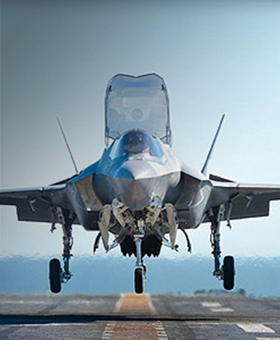
Amsterdam, 7 October 2009 - Today Lockheed Martin signed a 18.8 million US$ contract with Dutch Space and NLR for the development of a multi-ship, embedded training system for the F-35 Lightning II, known as the Joint Strike Fighter (JSF). Dutch Space and NLR, the National Aerospace Laboratory in the Netherlands, will execute the contract in an Integrated Project Team (IPT) which will lead to the initial implementation of embedded training in Block 3 aircraft in 2011. The embedded training system - providing multi-ship interaction, local and distributed weapons simulation, data link, data collection and off-board debriefing - is expected to become a standard feature in the F-35.
| | |
|
 |
Highlights at Dutch Space
CX2: a very small Geo communications satellite
Affordable service for niche markets 
CX2 is a very small Geostationary platform for telecommunication applications meeting today's Geo communication satellite standards. With a wet mass of 1,300 kg this novel satellite offers telecommunication satellite operators competitive solutions for a small customer base, as CX2 is optimized to reach the Geo arc at very low launch costs. In principle, the innovative spacecraft can also be used for missions in other high orbits, or even for deep space applications. Its key technology is an all electric propulsion system, with which it is able to travel to its operational Geo location after separation from the launcher. As a lowest cost solution for Geo missions, CX2 is expected to attract budget driven customers in Europe and elsewhere for both commercial and institutional missions.
Dutch Space successfully demonstrates improved SPADES Mark2 systems at PATCAD 2009
From 19-23 October 2009, Dutch Space once again successfully demonstrated the capabilities of its precision airdrop system called 'SPADES' at the Precision Airdrop Technology Conference & Demonstration (PATCAD) organized in Yuma, Arizona. As a fourth-time participant, Dutch Space, the only European company taking part in the flight demonstrations, introduced its improved SPADES 1000 and SPADES 300 ("ULW") Mark2 systems to a broad audience of military organizations coming from over fifteen different nations. Once again the performance of SPADES was very consistent and top-class, also show-casing a number of new system features that were incorporated based on feedback of military users.
Officiele opening nieuw kantoorgebouw (Dutch) |  | Donderdag 16 april was dé dag van de opening van het nieuwe gebouw van Dutch Space. Een feestelijke ontvangst van ruim 120 mensen, onder wie natuurlijk speciaal genoemd moeten worden minister Maria vd Hoeven, tweedekamerlid mevr. Marianne Besselink, de Leidse wethouder Marc Witteman, en van de kant van Astrium de heren François Auque, Evert Dudok en Andreas Lindenthal. Naast zoveel andere gasten die Dutch Space een warm hart toe dragen. |
Dutch Space levert zonnepanelen GOCE (Dutch) |  | De zonnepanelen van GOCE zijn bijzonder van vorm - het zijn een soort vleugels - en ze zijn speciaal door Dutch Space voor deze missie ontworpen. Ze voldoen aan extreme eisen wat betreft stijfheid, sterkte en totaal elektrisch vermogen. De gehele satelliet heeft een bijzondere vorm om de wrijvingsweerstand te minimaliseren. Zelfs op de hoogte van 268 km waarop GOCE opereert, kunnen vrije moleculen die tegen de satelliet botsen de extreem nauwkeurige metingen verstoren. Om dit te vermijden, zijn de panelen als 'vleugels' ontworpen. Ook mogen de extreme temperatuursverschillen tussen volledige blootstelling aan de zon en verduistering achter de aarde niet resulteren in een plotseling 'zetten' van de structuur omdat dat direct de metingen zal ruïneren.
De totale missie zal 20 maanden duren, waarin de satelliet zijn extreem nauwkeurige metingen moet gaan verrichten in twee periodes van zes maanden. |
Looking back on Dutch Spaceflight Year 2008

Netherlands Space Year 2008 (Picture Slide Show, Windows only, 22751 KB)
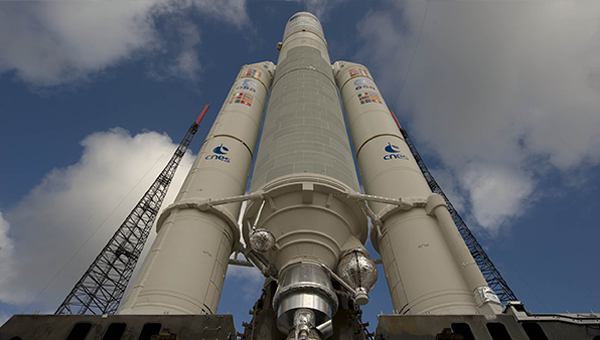
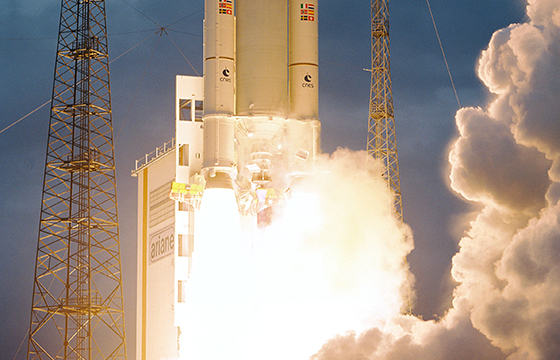
Vega |  | Dutch Space is responsible for the development of the Vega Interstage 1-2, the new European small launcher.. |
SPADES Precision Airdrop System |  | From 26-29 May 2008, Dutch Space once again successfully demonstrated the capabilities of their precision airdrop system called 'SPADES'. The occasion for these demonstrations was the NATO Precision Airdrop Capability Demonstration (PACD) organized by the French defense organization DGA. The demonstrations were held on the Center d'Essais Lancement de Missiles (CELM) test range along the Atlantic coast near the town of Biscarrosse. In front of an audience coming from over 15 different NATO countries, Dutch Space presented their newest operational 300 kg (750 lbs) and 1,000 kg (2,200 lbs) systems. Once again it was demonstrated that the performance of SPADES is consistently top-class. These commercial available SPADES systems will provide its military and civil users with the capability to very accurately and consistently deliver valuable goods to any target location within a 30 km range of the aerial drop point. SPADES can therefore be a life-, time- and/or cost-saving asset to any re-supply or tactical operation. |
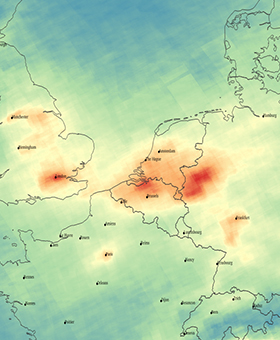
| Ozone Monitoring Instrument (OMI) |  | Since 2004 the Ozone Monitoring Instrument (OMI) is collecting data on the global concentration of atmospheric ozone on a daily basis, and it does this with a so far unsurpassed resolution. This information is useful for the prediction of the (local) intensity of ultra-violet radiation and smog formation. The OMI instrument - part of NASA's EOS-AURA satellite - was developed by Dutch Space and TNO. |
 Dutch Space holds several certifications for its Quality Management System: ISO 9001, AS 9100B, AQAP 2110, ISO 14001
|